

Raportul de aur în designul zâmbetului
In smile design, the golden ratio (about 1.618) is used as a visual guide for balancing the widths of the front teeth and how they sit within the lips and face. Dentists measure visible tooth proportions, gum symmetry, and smile line dynamics, then adjust shapes and spacing to create a natural, harmonious look that still fits the individual.
Smile design is a personalised plan that improves how the teeth, gums, and lips work together when you talk and smile. It combines aesthetics with function—so the result looks good, feels comfortable, and supports long-term oral health. The golden ratio is sometimes used during planning to check whether proportions look balanced to the eye.
Ce este Smile Design?

Smile design is the process of planning an ideal smile in harmony with a person’s facial features, lip movement, and oral health. It often starts with photographs, short videos, and dental scans so the dentist can analyse tooth display, gum levels, and bite function.
Depending on the case, treatment may include whitening, porcelain veneers, zirconia crowns, orthodontic alignment, or gum contouring. The goal is proportional harmony: the front teeth should look like they belong to the face, not like a “one-size-fits-all” template.
Ce este raportul de aur?
The golden ratio (approximately 1.618) is a mathematical proportion that appears in many natural patterns and has been used in art and design. In dentistry, it’s treated as a reference point for visual balance—helpful during planning, but not a strict rule that every smile must follow.
Cum folosesc stomatologii măsurătorile raportului de aur pe față
Facial proportions influence how we perceive a smile. During smile design, clinicians may check broad facial relationships—such as facial height to width, midline alignment, and how the lips frame the teeth—before choosing tooth shapes and display.
Common facial guidelines that are sometimes compared with the golden ratio include:
- Lungimea feței ÷ lățimea feței ≈ 1,6
- Distanța inter-pupilară ÷ lățimea ochiului ≈ 1.618
- Lățimea nasului ÷ lățimea gurii ≈ 1.618
- Frunte, mijlocul feței și treimi inferioare ale feței care sunt echilibrate vizual
Cum se măsoară proporția de aur în dinți
In smile design, golden ratio calculations are usually discussed for the visible widths of the upper front teeth when viewed from straight on. A commonly cited relationship is:
- Lățimea vizibilă a incisivilor centrali = 1,0 unitate
- Lățimea vizibilă a incisivilor laterali ≈ 0,618 unități
- Lățimea vizibilă canină ≈ 0,382 unități
These numbers describe how the teeth appear across the smile, not their true anatomical widths. Because tooth rotation, arch form, and camera angle change what is “visible,” dentists treat this as a starting point rather than a target.
Example: If a central incisor appears 8.5 mm wide from the front, a lateral incisor might look about 5.3 mm (8.5 × 0.618) in the same view. The canine’s visible width would be smaller again, because the tooth sits further back in the arch.
Ce elemente sunt luate în considerare în designul zâmbetului?

A complete smile design review looks beyond tooth size. Clinicians typically assess:
- Culoarea și transluciditatea dinților (deseori susținute de albire înainte de restaurări)
- Dimensiunea, forma și simetria dintelui (inclusiv unghiurile liniei și poziția marginii incizale)
- Nivelul gingiilor și sănătatea gingiilor (simetrie, controlul inflamației și factori „zâmbet gummy”)
- Forma buzelor și mobilitatea (cât de mult dinți arată în repaus și în timpul unui zâmbet plin)
- Forma feței și arcul zâmbetului (cum marginile incizale urmează linia buzei inferioare)
- Preferințe de exprimare a vârstei și a genului (forme mai blânde versus forme mai clare, când este cazul)
Cum se aplică raportul de aur într-un flux de lucru de design zâmbet

In modern practice, golden ratio checks are typically built into a broader digital workflow. A typical sequence looks like this:
- 1. Fotografie și măsurători: fotografii faciale și intraorale (adesea cu video) plus scanări digitale.
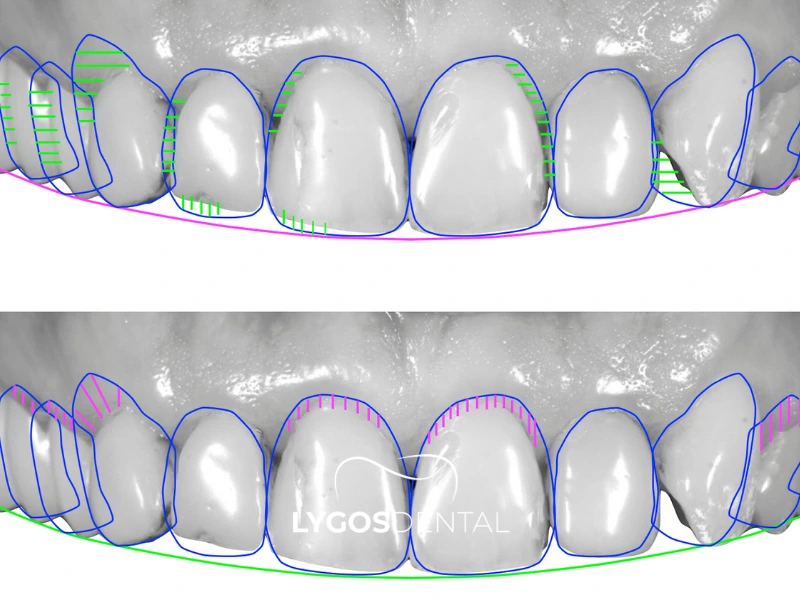
- 2. Digital Smile Design (DSD): simulare software pentru a testa proporțiile dinților, linia mediană și arcul zâmbetului.
- 3. Planificarea tratamentului: selectarea procedurilor precum albirea, fațetele, coroanele, ortodonția sau remodelarea gingiilor.
- 4. Zâmbet machetă sau de probă: o previzualizare temporară (dacă este cazul) pentru a valida estetica și confortul vorbirii.
- 5. Livrare finală și urmărire: restaurări finale plus verificări ale mușcăturii și îndrumări de igienă.
Unde ajută Rata de Aur – și unde nu
The golden ratio can be useful for communicating “balance” between teeth, especially when planning veneer or crown widths. Still, research across different populations shows that naturally attractive smiles often do not match a single fixed ratio. That’s why many clinicians prefer flexible frameworks (such as percentages or recurring aesthetic proportions) over strict formulas.
For durable results, function and biology must lead the plan. Bite stability, enamel thickness, gum health, and restorative material limits will often set the boundaries for what is realistic—even if a ratio looks ideal on screen.
Întrebări frecvente privind raportul de aur în designul zâmbetului
De ce se folosește proporția de aur în designul zâmbetului?
Because it provides a simple visual reference for harmony between the front teeth and the face. Used carefully, it can help guide tooth width dominance (central vs lateral vs canine) and support a balanced, natural look.
Cum se aplică raportul de aur pe dinții din față?
Clinicians measure the visible widths of the upper front teeth from a straight-on view and compare the proportions as the teeth move toward the corners of the smile. If changes are needed, they may adjust tooth shape, spacing, or alignment through orthodontics or restorations.
Dinții trebuie să fie sănătoși înainte de a începe designul zâmbetului?
Yes. Any active decay, gum disease, or bite instability should be treated first. Aesthetic dentistry lasts longer when the foundation—clean gums, stable bite, and good oral hygiene—is in place.
Se aplică proporția de aur diferit pentru bărbați și femei?
The mathematics do not change, but the design choices can. Some patients prefer softer contours and rounded line angles, while others prefer squarer forms and stronger definition. A good plan matches the person’s facial features and preferences rather than forcing a single template.